Thermal vs. Night Vision: Choosing the Right Tool for Nocturnal Marksmanship
A detailed comparison of thermal imaging and image intensification technologies for hunting, tactical operations, and long-range shooting — covering detection ranges, identification capability, and practical field considerations.
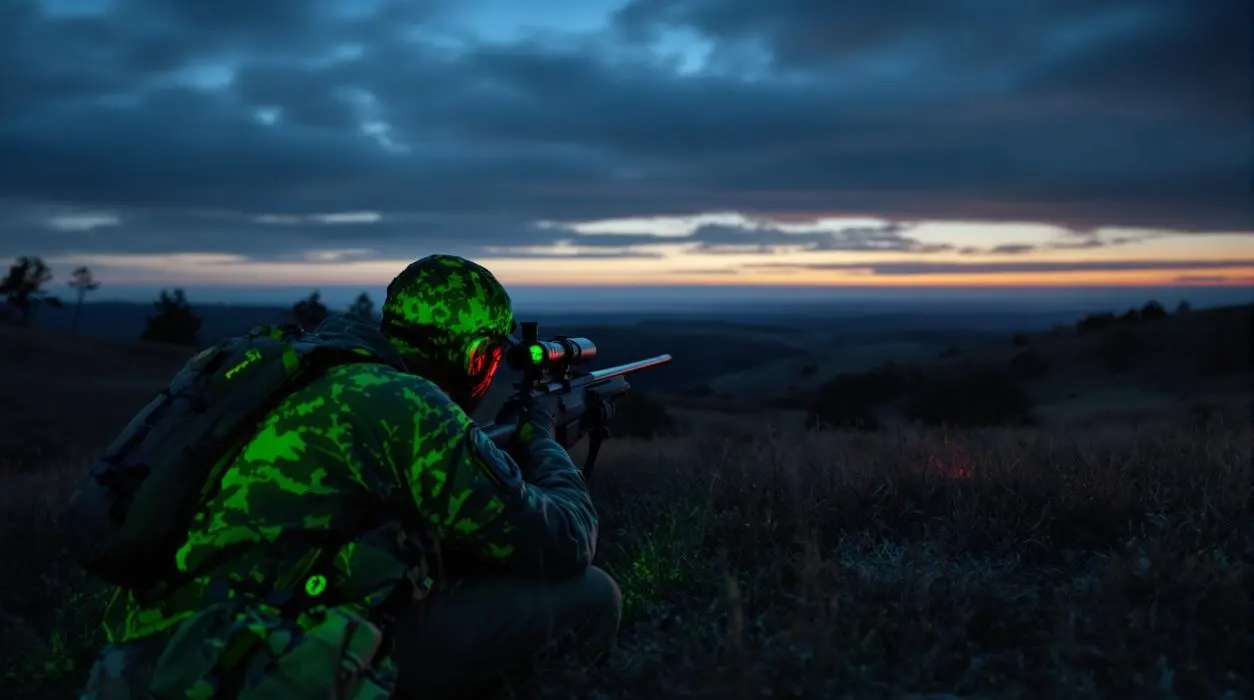
Table of Contents
The debate between thermal imaging and traditional night vision is one of the most persistent discussions in the precision shooting community. Both technologies enable operation in darkness, but they do so through fundamentally different mechanisms, each with distinct advantages and limitations. Understanding these differences is critical for making informed equipment decisions.
Detection: Thermal Wins
For pure detection — finding a target in darkness, concealment, or adverse conditions — thermal imaging holds a decisive advantage. A warm-blooded animal or human stands out dramatically against cooler backgrounds, regardless of camouflage or concealment. Modern thermal scopes can detect a human-sized heat signature at distances exceeding 2,000 meters, well beyond the effective range of most image intensification devices with equivalent optics.
Thermal sensors also see through light fog, smoke, dust, and sparse vegetation — conditions that severely degrade or completely defeat traditional night vision. For search-and-locate applications, thermal is the clear winner.
Identification: Night Vision Prevails
Where night vision excels is in target identification. A Gen 3 image intensification tube provides a detailed, high-resolution image that allows the shooter to identify facial features, read markings, and distinguish fine details that thermal sensors simply cannot resolve. A thermal image tells you something warm is there; a night vision image tells you who or what it is.
This distinction has legal and ethical implications. In hunting, positive identification of species and sex is often legally required before taking a shot. In tactical applications, distinguishing between combatants and non-combatants — or between a rifle and a tool — can mean the difference between a justified engagement and a tragic mistake.
Environmental Considerations
The environment heavily influences technology choice. In open terrain with good ambient light — moonlight, starlight, or urban illumination — a quality Gen 3 device provides exceptional situational awareness with a natural-feeling image. In total darkness, heavily forested areas, or conditions with no ambient light, night vision requires supplemental IR illumination, which can reveal the user's position.
Thermal scopes are unaffected by ambient light levels but can struggle with thermal crossover — the brief periods at dawn and dusk when the ground and ambient air temperatures equalize, reducing contrast between targets and backgrounds. Heavy precipitation also attenuates thermal signals more than visible light.
The Hybrid Future
The emerging solution is fusion technology — combining thermal overlay with image intensification in a single device. Systems like the AN/PSQ-20 Enhanced Night Vision Goggle (ENVG) overlay thermal hot spots onto the intensified image, providing the detection advantages of thermal with the identification capability of traditional night vision. As this technology matures and becomes more affordable, the thermal-versus-night-vision debate may become increasingly academic.