Thermal vs. Night Vision: Choosing the Right Tool for Nocturnal Marksmanship
The choice between thermal imaging and night vision begins with a physical distinction, not a brand name. A thermal device detects infrared radiation associated with temperature differences. An image-intensifying night sight gathers available light and amplifies it into a visible image. Both can support observation after dark, but they do not show the same information […]
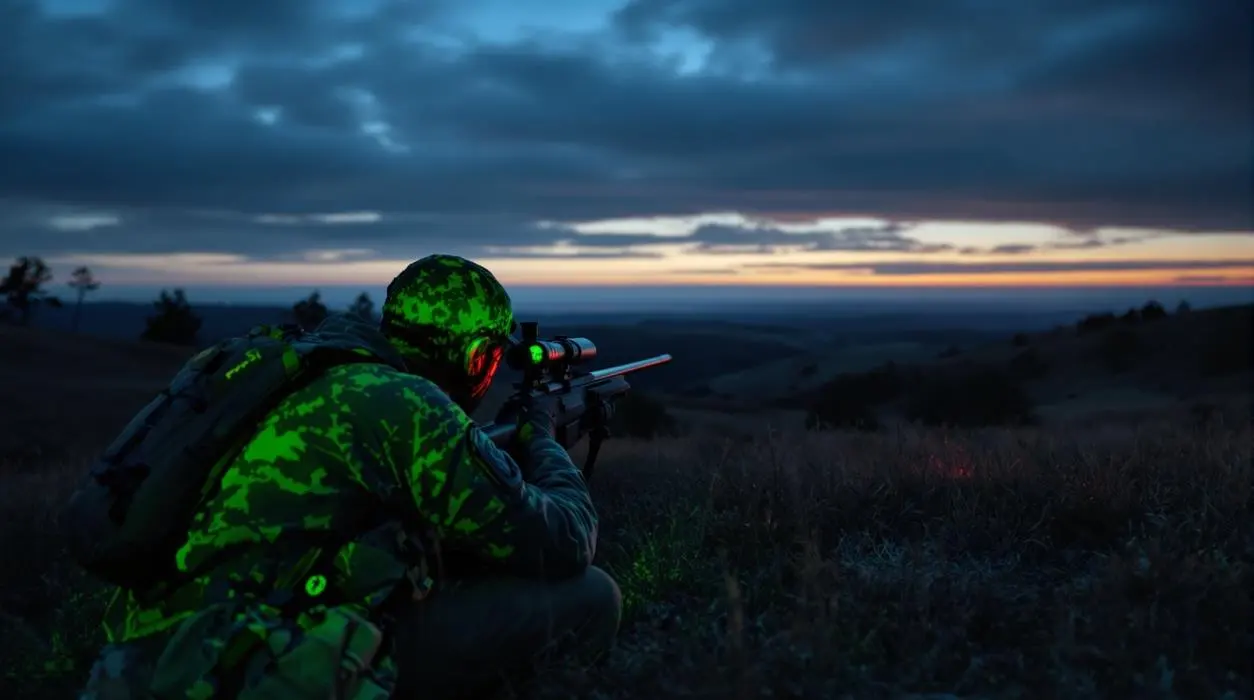
The choice between thermal imaging and night vision begins with a physical distinction, not a brand name. A thermal device detects infrared radiation associated with temperature differences. An image-intensifying night sight gathers available light and amplifies it into a visible image. Both can support observation after dark, but they do not show the same information or fail under the same conditions.
That difference matters when accounts describe a nighttime hit, a long-range observation or a rifle fitted with a "night scope." Historical reports often use broad language that conceals the actual equipment. A passive image intensifier, an active infrared system and a thermal sight may all be grouped together, even though their capabilities and limitations are substantially different.
Two sensors, two kinds of evidence
Night vision is fundamentally a light-management technology. An image-intensifier tube receives photons, commonly from the visible and near-infrared portions of the spectrum, converts them into electrons and amplifies the signal before displaying an image. It still needs some illumination from the moon, stars, artificial light or another source. In very dark conditions, the image may become noisy or disappear altogether.
Thermal imaging works from emitted infrared energy rather than reflected starlight. A warm body, a vehicle that has recently operated and a sun-heated surface can produce contrasts that remain visible when the scene looks black to the unaided eye. The display is not a photographic record of colour or texture. It is a map of relative radiant temperature, shaped by emissivity, distance, weather and the sensor's processing.
This distinction explains why a thermal image can reveal something that night vision misses, while night vision can preserve detail that thermal imaging does not. The first device may detect a heat contrast; the second may offer a more familiar view of form, terrain and equipment.
Detection is not identification
For nocturnal marksmanship, the most consequential divide is between finding a possible object and identifying it with sufficient confidence. Thermal imagers are often strong at detection because a person, engine or recently disturbed surface may contrast with its surroundings. That advantage can persist in darkness where image intensification has little light to amplify.
Identification is harder. A thermal outline may show that something is present without resolving clothing, equipment, facial features or fine terrain detail. Different objects can share similar apparent temperatures, and a cold object may blend into a background with comparable radiance. Digital sharpening and colour palettes can make an image easier to read, but they do not create information the detector never recorded.
Night vision generally provides a more recognizable scene when illumination is adequate. Edges, vegetation, structures and surface patterns may appear in a way that supports interpretation. Its weaknesses become pronounced in heavy shadow, smoke, dense foliage or conditions where the available light is insufficient. A clear green or monochrome image is not proof that the sight has enough information for a reliable shot.
The distinction should appear beside any historical claim involving nighttime accuracy. A report that says a marksman "saw" a target does not establish whether the device detected heat, intensified light, used an infrared illuminator or provided enough resolution for positive identification.
Why the rifle optic changes the problem
A night-capable rifle optic is not simply a daylight scope with a darker display. The sight must preserve a usable aiming reference while the sensor, reticle, mount, rifle and ammunition remain aligned. Optical magnification can enlarge a target image, but it cannot restore resolution lost in the sensor, atmosphere or focus system.
Image-intensifying sights often resemble conventional rifle optics more closely because they form an image from reflected light. Their performance depends on tube sensitivity, optical quality, ambient illumination and the control of blooming from bright sources. A sudden lamp, flare or muzzle flash can overwhelm the image or complicate the observer's view.
Thermal sights use a detector and display whose characteristics differ from those of a glass riflescope. Resolution, refresh behaviour, focus, field of view and digital magnification all affect how an aiming point appears. A thermal reticle may remain visible against a dark background, yet the scene around it can lack the fine reference points that help a shooter judge alignment and target position.
The record trail is frequently incomplete at this stage. Equipment lists may name a rifle and a broad optic category while omitting the sight model, objective size, magnification, ammunition, zeroing method and whether a separate observer assisted. Without those details, a claimed distance cannot be compared fairly with another nighttime result.
Weather exposes the difference
Atmospheric conditions can reverse an apparent advantage. Fog, rain, snow, dust and smoke scatter or absorb infrared energy and visible light in different ways. Thermal imaging may retain useful contrast in some obscured conditions, but moisture between the sensor and subject can reduce detail and effective range. Night vision can also lose contrast, particularly when haze scatters stray light back into the tube.
Vegetation presents another complication. Thermal energy does not automatically pass through leaves, grass or branches. A warm object may be partly concealed, while a sunlit or heat-retaining plant can produce misleading patterns. Night vision may show the intervening foliage more naturally, but that does not make a concealed object visible.
Temperature changes across the day affect thermal contrast as well. Near sunrise or sunset, ground, rock, timber and metal may approach similar apparent temperatures. This period is often called thermal crossover in practical discussions, though its exact effect depends on materials, weather and the sensor. A statement that a thermal sight "works in total darkness" is therefore technically true but incomplete: darkness is only one part of the observation problem.
Active infrared belongs in a separate category
Historical descriptions sometimes blur passive night vision with active infrared equipment. Early military night systems used an infrared illuminator to project energy into the scene, with a receiver or image converter returning the reflected signal to the operator. Such systems were not passive, and their use could create a detectable infrared signature for an observer equipped to see it.
Later image-intensifying systems reduced or eliminated the need for an illuminator under suitable conditions. That change altered concealment, battery use and the practical design of night observation. It did not remove the dependence on ambient photons. Thermal devices followed a different path by sensing emitted radiation, although they brought their own requirements for detector sensitivity, calibration, power and image interpretation.
When a wartime memoir or after-action report refers to an "infrared scope," the designation should not be treated as proof of a particular technology. The date, manufacturer, power source, illuminator, photographs, surviving manuals and unit records may be needed to establish what the term meant in that context. A famous name attached to a device is not the same as a verified equipment record.
What repeated nighttime records actually establish
Long-range nighttime claims are difficult to compare because the underlying conditions are rarely standardized. Distance may be measured from a map, a rangefinder, a firing point or a later reconstruction. The target may be stationary or moving, illuminated or unilluminated, exposed or partly concealed. A confirmed hit, a claimed hit and a confirmed casualty are different categories of evidence.
Repeated publication can strengthen a reputation without strengthening the original documentation. One account may copy another, changing an approximate distance into a precise figure or replacing an unnamed optic with a familiar designation. Wartime statistics can be especially difficult to audit because unit logs, personal accounts and later histories may disagree, while the original sensor and ammunition data have disappeared.
A careful archive should preserve the exact claim and its qualification together. "A reported nighttime engagement at approximately this distance" is more defensible than presenting an untraceable figure as a standing record. The same discipline applies to equipment: a photograph can establish that an optic was present, but it may not establish its internal technology or performance in the stated conditions.
Selecting the technology by the information required
Thermal imaging is usually the stronger tool when the first task is detecting a warm object against a cooler or otherwise contrasting background. It can be valuable in darkness and may reveal activity that reflected-light systems do not. Its image, however, must be interpreted with care when the task requires precise identification, fine detail or separation between objects with similar thermal signatures.
Night vision is often preferable when available light supports a detailed scene and the observer needs recognizable terrain, equipment or movement. It can provide a more intuitive visual reference for a conventional rifle optic, but darkness, glare and obscurants can quickly reduce its usefulness. Neither technology removes the need to establish what is being observed before any precision-shooting claim is accepted.
For serious historical comparison, the most useful question is not which system is universally better. It is what the original observer needed to detect, what the environment allowed the sensor to record and what evidence survives to prove the result. The answer may favour thermal imaging, passive night vision, active infrared or a combination, but the surviving record must carry the designation rather than the legend.