Thermal Scopes in Modern Combat: How Heat Detection Changed the Battlefield
A rifle optic can produce a clear image and still leave the observer uncertain about what is being seen. At night, a dark shape may be a person, a vehicle component, warm ground, or an artifact introduced by the sensor itself. Heat-sensitive imaging addressed that practical problem by detecting differences in infrared radiation rather than […]
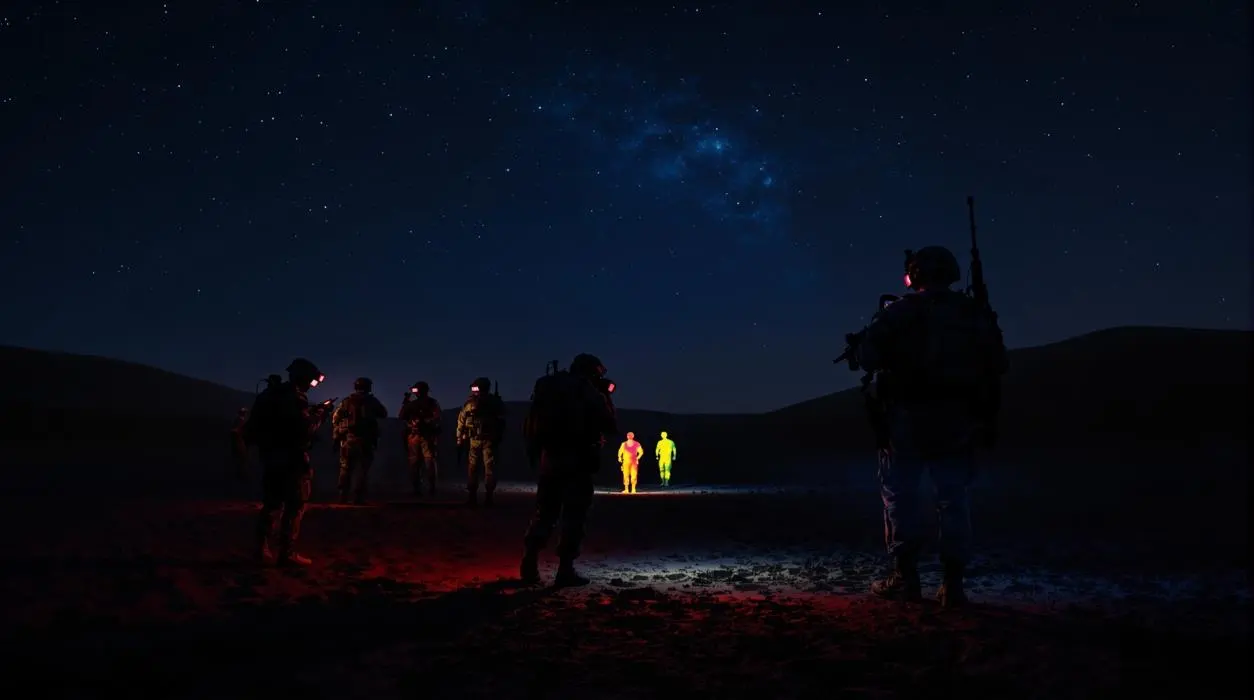
A rifle optic can produce a clear image and still leave the observer uncertain about what is being seen. At night, a dark shape may be a person, a vehicle component, warm ground, or an artifact introduced by the sensor itself. Heat-sensitive imaging addressed that practical problem by detecting differences in infrared radiation rather than depending on reflected light. The result was a major change in battlefield observation, but not a magic window through darkness. Understanding what the equipment could reveal, what it could not, and how operators checked its information remains more useful than treating every bright outline as a confirmed target.
From Starlight Amplification to Thermal Contrast
Early military night vision and thermal imaging solved different problems. Image intensifiers, including the active infrared equipment used by Germany's Zielgerät 1229 Vampir during the Second World War, amplified available light or relied on an infrared illuminator. The Vampir was a genuine night-fighting system, but it was not a thermal sight. That distinction matters because it separates heat detection from the longer history of low-light optics.
Thermal instruments detect infrared energy emitted by objects. They do not need moonlight, starlight, or an onboard illuminator. A warm engine, a recently occupied position, and exposed skin may contrast with cooler surroundings even when the visible scene is nearly black. Early military systems were large, costly, power-hungry and often built around cooled detectors. Their value was therefore concentrated in vehicles, surveillance posts and other applications where size and logistics were manageable.
The technology became more widely distributed as uncooled microbolometer sensors matured. These sensors do not require the cryogenic cooling used by many older high-performance detectors, making man-portable sights more practical. The trade-off is that compact equipment still has to balance sensitivity, resolution, battery life, weight and cost.
The Systems That Made Heat Visible
Thermal imaging entered battlefield practice through several overlapping routes rather than one universally accepted breakthrough. Armored vehicles received sophisticated thermal viewers for driving, observation and fire control. Infantry units later gained weapon sights, clip-on modules and handheld viewers. The US AN/PAS-13 Thermal Weapon Sight family is a well-known example of the latter development, appearing in multiple variants and configurations rather than as one unchanging device.
The same period saw thermal cameras used for surveillance, vehicle-mounted observation and airborne sensing. Systems differed in detector type, optical design, image processing and intended range. A sight made for a crew-served weapon did not necessarily provide the same field of view or handling characteristics as a compact optic carried by an individual soldier.
That distinction is easy to lose in photographs and equipment lists. A designation confirms that a system existed; it does not, by itself, establish its exact resolution, effective range in a given environment, or use in a particular engagement. Those details require technical manuals, procurement records, unit documentation or carefully sourced contemporary reporting.
What the Sensor Actually Measures
A thermal sight does not see heat as a simple red-hot overlay. Its detector measures infrared radiation and converts differences into a displayed image. Most uncooled military and commercial systems operate in the long-wave infrared band, commonly around 8 to 14 micrometres, though equipment varies. The display may use white-hot, black-hot or a colour palette, but the palette is a viewing choice rather than a direct photograph of temperature.
Several specifications deserve more attention than headline magnification. Detector resolution affects how much spatial detail can be represented. Thermal sensitivity, often described through noise-equivalent temperature difference, influences the visibility of small temperature contrasts. Field of view determines how easily an observer can search, while digital zoom may enlarge pixels without adding information. Refresh rate, focus range, calibration behaviour and battery endurance also shape practical use.
A simple workshop check illustrates the point. If a familiar object becomes less distinct after digital magnification, the problem may be limited detector detail rather than poor focus. If the whole scene shifts suddenly in brightness, a calibration cycle or changing thermal conditions may be responsible. If a warm object blends into a similarly warm background, greater magnification will not restore contrast that the environment has removed.
The Checks That Prevent False Confidence
Heat detection is strongest when temperature differences have a useful cause. Engines, recently handled equipment, exposed people and surfaces warmed by the sun can stand out. That contrast can fade as objects cool, and it can be distorted by wind, rain, humidity, vegetation, masonry and changing ground temperatures.
A practical observer checks the scene at more than one setting rather than trusting a single palette. Focus should be adjusted for the actual observation distance. The sight's objective lens and protective window need inspection for moisture, dirt or damage, but cleaning must follow the equipment's approved procedure. Battery condition matters because some systems alter performance or shut down features as power falls.
Thermal imaging also has firm physical limits. Ordinary glass often blocks the long-wave infrared wavelengths used by many systems, so looking through a window may show reflections or the glass surface rather than the scene beyond it. Walls are not transparent. Smoke, dust, foliage and weather can reduce contrast, and a thermal signature does not automatically identify an object, its affiliation or its intent.
These checks are not minor technicalities. They are the difference between using a sensor as evidence and treating its display as certainty.
How Heat Detection Altered Battlefield Practice
The most consequential change was not simply the ability to aim at night. Thermal sensors expanded the hours in which units could observe, move, search and coordinate. They also reduced the advantage once provided by darkness, allowing vehicles and infantry to detect heat contrasts without relying on visible illumination.
For precision shooters, the technology changed observation and target discrimination, but it did not remove the underlying problems of range estimation, atmospheric effects, stability, ammunition performance or human identification. A thermal image can help locate a warm shape while offering less detail about clothing, equipment or background than a high-quality daylight image. In some conditions, a fused system combining thermal and image-intensified views gives a more informative result than either sensor alone.
The wider battlefield response followed quickly. Heat management became part of concealment planning, while armies developed better ways to reduce, mask or confuse infrared signatures. Vehicle exhausts, engines, body heat and recently disturbed ground became part of the information contest. This was a sensor and counter-sensor development, not a permanent one-sided advantage.
Evidence, Records and the Problem of Attribution
Claims about thermal equipment often become stronger as they are repeated. A photograph may show a sight mounted on a rifle, but it does not prove that the optic was used during a particular shot. A procurement document can establish delivery or authorization, but not necessarily frontline distribution. A veteran account may be valuable evidence while still leaving the date, variant or tactical context uncertain.
The same caution applies to long-range engagements reported as demonstrations of advanced optics. A confirmed hit does not automatically prove the use of a thermal sight, and a sight's presence does not establish that thermal detection was decisive. Official after-action reports, maintenance records, unit histories and contemporaneous imagery can strengthen a case; anonymous retellings and promotional summaries deserve more careful qualification.
Equipment names also require precision. A thermal weapon sight, a vehicle thermal viewer, a handheld reconnaissance camera and a clip-on module may share detector technology while serving very different purposes. Treating them as interchangeable can produce inflated claims about capability or historical adoption.
What the Technology Changed – and What It Did Not
The measured historical judgment is that thermal imaging changed battlefield visibility by making temperature contrast useful in darkness and poor light. It helped shift night operations from dependence on ambient illumination toward a broader sensor picture that included emitted infrared energy. That change affected vehicles, surveillance teams, infantry units and precision shooters alike.
It did not make identification automatic, eliminate camouflage, or guarantee accurate engagement. Weather, background temperature, sensor quality, operator training and the quality of supporting evidence continued to matter. The best records distinguish a documented system from an inferred one, a reported result from a verified result, and a sensor image from the conclusion drawn from it.
For readers assessing any claimed milestone, the sensible questions are modest: What exact equipment was involved? Is the date and designation documented? Was the image recorded under conditions that explain the claimed contrast? Which part is confirmed, which part is reported, and which part remains disputed? Those questions keep the history useful. Heat detection changed what soldiers could observe, but disciplined verification determined what they could responsibly conclude.