Thermal Optics Explained: How Heat Signatures Revolutionized Night Shooting
A dark landscape can defeat ordinary glass long before it defeats a thermal sensor. Foliage, shadows and an overcast sky may leave a conventional sight with little useful detail, while a warm object still produces a detectable contrast. That difference has changed night shooting, wildlife observation, search work and military reconnaissance alike. The practical question […]
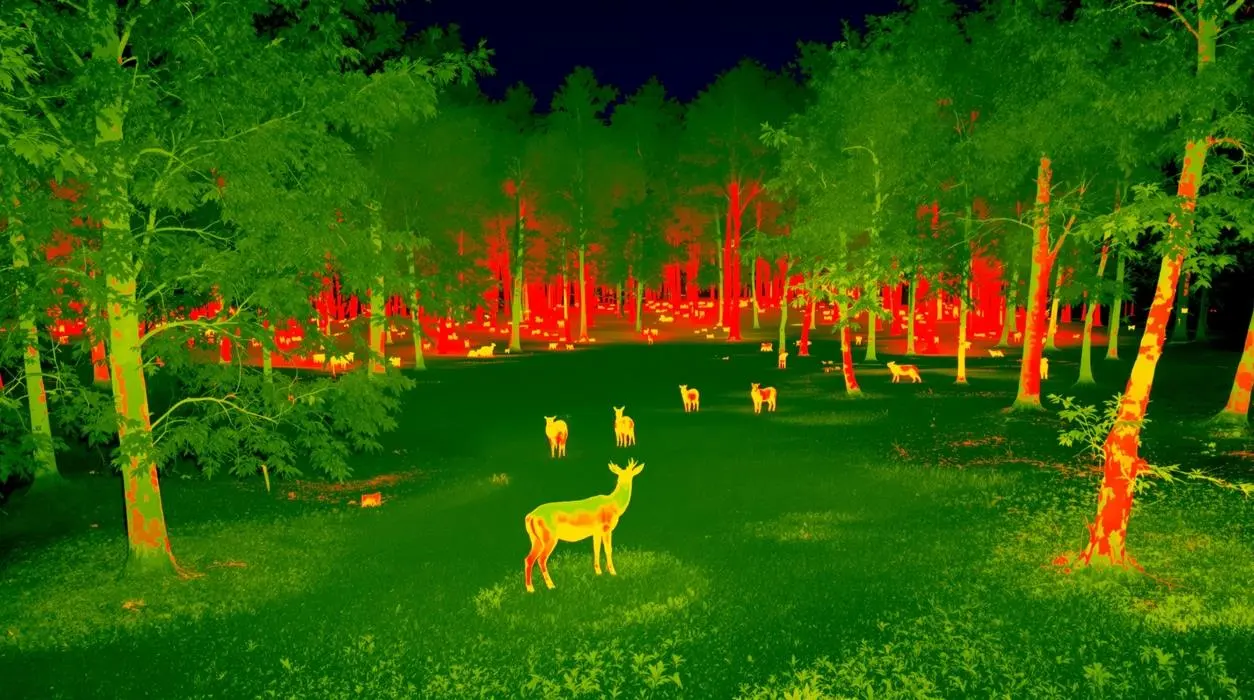
A dark landscape can defeat ordinary glass long before it defeats a thermal sensor. Foliage, shadows and an overcast sky may leave a conventional sight with little useful detail, while a warm object still produces a detectable contrast. That difference has changed night shooting, wildlife observation, search work and military reconnaissance alike. The practical question for an owner is not whether thermal imaging is powerful, but which type of system suits the task, how its image should be interpreted, and where its apparent certainty can mislead.
From Infrared Radiation to a Usable Image
All objects emit infrared radiation as a function of their temperature. A thermal sight uses an optical assembly and an infrared detector to measure variations in that radiation, then converts the measurements into an image. The display may show warmer areas as white, black or a selected colour, but those colours are visual conventions rather than literal photographs of temperature.
Thermal imaging is therefore different from visible-light photography and from image intensification. Image intensifiers amplify available light, including starlight and artificial illumination. A thermal device senses emitted radiation and can work in complete darkness, provided the scene contains enough temperature contrast for the detector to separate objects from their background.
The underlying science is not new. Samuel Pierpont Langley's bolometer, developed in the late nineteenth century, demonstrated that very small changes in radiant heat could be measured. Practical infrared imaging matured much later as detector materials, electronics and display technology improved. Military and industrial users helped drive that progress, especially where visibility, surveillance and equipment inspection mattered more than compact size or low cost.
The Systems That Changed Night Observation
Early military thermal imagers were generally large, expensive and dependent on cooled detectors. Cooling reduced electronic noise and improved sensitivity, but it required a cryogenic assembly, added weight and increased maintenance demands. Such equipment belonged to vehicles, aircraft or specialist surveillance teams rather than ordinary individual users.
The spread of uncooled microbolometer arrays made thermal imaging far more accessible. A microbolometer changes its electrical properties when infrared energy warms it. The sensor does not need the same type of cryogenic cooler used by many high-performance cooled systems, allowing smaller sights, handheld viewers and clip-on devices to be built with fewer moving parts.
This distinction still matters. Cooled systems can offer greater sensitivity, longer detection ranges and faster response in demanding applications, but they are more complex and costly. Uncooled equipment is usually easier to carry and operate, making it the more practical choice for many observation and sporting applications. Neither category guarantees recognition at long distance; optics, atmospheric conditions, target size and image processing remain decisive.
Modern thermal sights also owe much to advances in digital processing. Automatic gain control, multiple display palettes, digital zoom, recording and wireless functions can make a compact unit versatile. They can also create a false impression that software has solved the basic limits of the sensor. It has not.
What the Specifications Really Tell You
A buyer often begins with resolution, but resolution is only one part of the image. A detector described by its pixel dimensions can show finer patterns when the optics and processing preserve that detail. A larger objective lens may collect more infrared energy and support better performance at distance, although it can increase bulk and alter balance on a mounted system.
The key specifications deserve separate attention:
– Spectral band: Many uncooled devices operate in the long-wave infrared region, while some cooled systems use a mid-wave band. Atmospheric transmission and detector design affect the result.
– Sensitivity: Often expressed as noise-equivalent temperature difference, this indicates how small a temperature contrast the system can distinguish. Lower values are generally better, but laboratory figures do not describe every field condition.
– Refresh rate: A higher rate can produce smoother movement and reduce display lag. It may matter more for scanning or moving observation than for a stationary scene.
– Field of view: A wide view helps locate objects and monitor an area. A narrow view enlarges a smaller portion of the scene but can make searching slower.
– Focus and calibration: A sharp, correctly calibrated image is more useful than a high-resolution sensor viewed through poorly adjusted optics.
Detection, recognition and identification are not interchangeable claims. A device may reveal a warm shape at a distance without showing enough information to establish what that shape is. Marketing language sometimes compresses these separate tasks into a single range figure. Treat such numbers as test conditions, not universal promises.
Choosing Between Thermal, Image Intensified and Hybrid Views
Thermal optics make the most sense when darkness, shade, camouflage or background clutter limits visible-light equipment. They are especially useful for locating warm animals, checking a dark perimeter, spotting recently used machinery or observing a scene where a visible lamp would be intrusive. A thermal viewer can also complement a daylight optic rather than replace it.
Image intensification remains valuable when the user needs more natural scene detail. Fences, branches, terrain contours and printed markings may be easier to interpret through a good intensified image under suitable ambient light. Infrared illuminators can extend that capability, though they introduce their own power, visibility and equipment considerations.
Hybrid systems combine channels, but they are not automatically the best choice. They cost more, add controls and can complicate training. A hunter who mainly needs to locate an animal in darkness may prefer a simple thermal monocular. An observer who must read terrain and identify equipment may value a visible or intensified channel. A professional team with varied tasks may accept the extra complexity of a fused system.
Mounting is another decision. A dedicated thermal weapon sight is designed around the sighting system and its controls. A clip-on unit can preserve a familiar daylight optic, but alignment, eye relief, mounting repeatability and compatibility require careful checking. An observation monocular should not be assumed to work safely or accurately as a weapon-mounted sight merely because it displays a clear image.
Heat Signatures Are Information, Not Identification
Thermal images show temperature contrast, not an object's full appearance. A person, animal, engine, sun-warmed rock or recently occupied seat can produce a bright shape. Wet materials, wind, rain and changing ground temperature may reduce contrast. Glass can reflect infrared radiation rather than reveal what lies behind it, and walls generally obscure the heat sources on the other side.
Vegetation is often misunderstood. Thermal energy does not simply pass through leaves and branches because the display shows a bright patch behind them. A sensor may detect exposed areas, gaps or heat transferred to the foliage. Dense cover can hide detail even when a shape appears to be present.
Emissivity also affects interpretation. Different surfaces emit and reflect infrared energy differently, so a temperature reading or tonal pattern can be misleading without context. This is why professional users compare movement, shape, background and time rather than treating the brightest object as the most meaningful one.
Common ownership mistakes follow predictable patterns: buying on advertised detection distance alone, neglecting calibration, using digital zoom as if it created optical detail, ignoring battery performance in cold weather, and failing to practise with the actual display palette. Another error is assuming that a thermal image automatically proves identity. It does not.
Limits, Evidence and Disputed Claims
Thermal performance depends heavily on weather and the scene itself. Rain, fog, high humidity and temperature changes can reduce contrast or transmission. A cool object against a cool background may be difficult to separate, while a warm object can remain conspicuous after sunset. Atmospheric effects accumulate with distance, and a specification measured under controlled conditions cannot establish a universal field range.
Historical claims also require care. Thermal imaging unquestionably transformed night observation by making emitted heat useful where visible light was absent. Claims that a particular device was the first, the most effective or responsible for a specific battlefield result often depend on incomplete procurement records, later recollections or promotional material. Equipment designations may refer to a family of variants rather than one identical configuration.
Documented facts should be separated from reported experience. A published detector format, operating band or development date can be checked against technical records. A claim that an optic enabled a particular observation may be credible without being independently reproducible. Combat effectiveness statistics are especially difficult to verify and should not be treated as precise measurements when the underlying reporting method is unclear.
A Measured Choice for Night Use
The best system is the one whose image the user can interpret consistently in the conditions that matter. Start with the task: locating, observing, identifying or maintaining a conventional sight picture. Then consider sensor sensitivity, field of view, focus, calibration, mounting, power and weather before giving headline range figures much weight.
Thermal technology revolutionized night shooting because it changed the problem from finding enough light to reading enough contrast. That is a major advantage, but not a substitute for judgment. A careful owner treats the display as a specialised measurement, checks what the scene can actually support, and remembers that clearer heat signatures do not always mean clearer answers.