The ZG 1229 Vampir: World War II’s Secret Night Vision System
A night sight is only useful when the whole system works together: the weapon mount, power supply, infrared source and viewing device must all survive the same conditions. That practical problem shaped the German Zielgerät 1229 Vampir, an early active-infrared aiming system associated with the StG 44 assault rifle. Its reputation has grown well beyond […]
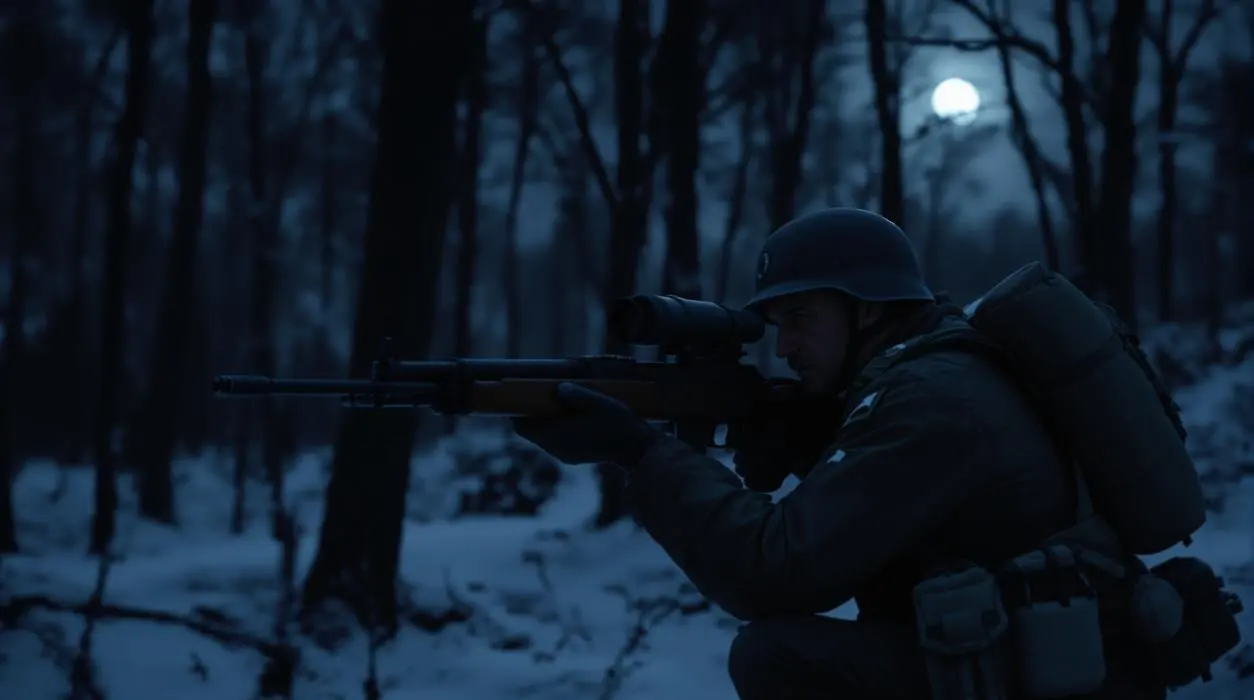
A night sight is only useful when the whole system works together: the weapon mount, power supply, infrared source and viewing device must all survive the same conditions. That practical problem shaped the German Zielgerät 1229 Vampir, an early active-infrared aiming system associated with the StG 44 assault rifle. Its reputation has grown well beyond the surviving evidence, yet the documented equipment remains significant. Examining what it could do, rather than treating it as a futuristic wonder, gives readers a clearer view of how military night vision moved from experimental apparatus toward field equipment.
Why infrared mattered in the late war
Conventional rifle sights depend on visible light, and moonlight alone does not solve every problem. A target may be difficult to identify through darkness, smoke, woodland or uneven terrain. Infrared offered a practical alternative: illuminate the scene with radiation outside normal human vision, then view the reflected signal through a compatible optical converter.
That approach was active rather than passive. The system did not simply amplify whatever faint light happened to be present. It carried its own infrared illuminator, which consumed power and created a larger equipment burden. The basic idea was already known before the Second World War, but wartime demands accelerated work on compact military devices in Germany, Britain, the United States and elsewhere.
The Vampir appeared during the final phase of the conflict, when German engineers were attempting to extract useful capability from increasingly difficult conditions. The designation Zielgerät 1229 translates broadly as aiming device 1229. "Vampir" was the familiar name attached to the system, although wartime naming, production records and later collector descriptions do not always align neatly.
The system built around the StG 44
The most commonly documented weapon pairing was the 7.92x33mm Kurz StG 44. The rifle provided a relatively compact platform, while the sight assembly added a substantial load above the receiver. This was not a small replacement for an ordinary front and rear sight. It was a complete night-aiming arrangement with its own optical head, infrared searchlight and battery equipment.
The development and manufacture of the device are generally associated with Allgemeine Elektrizitäts-Gesellschaft, better known as AEG, though surviving summaries often compress a wider industrial effort into one company name. Wartime electronics projects could involve separate firms for optical components, electrical equipment, mounting hardware and final assembly. That is one reason precise attribution should be stated cautiously unless it is tied to a specific document.
The soldier carrying the arrangement had to manage more than the rifle. Common descriptions place the battery pack in a backpack and connect it to the sight and illuminator by cable. The searchlight was mounted near the weapon, while the viewer sat above the receiver. The result was a self-contained package, but not a light one. Published figures vary by whether they refer to the sight alone, the weapon-mounted assembly or the complete system with batteries and accessories.
What the surviving specifications can support
The strongest general description is an active near-infrared system intended for short-range observation and aiming in darkness. It was not a thermal imager. Thermal equipment detects differences in emitted heat; the Vampir depended on an infrared source throwing usable illumination onto the scene. That distinction matters because it explains both the system's usefulness and its weaknesses.
Most technical accounts give the practical engagement range as roughly 100 metres, or about 110 yards, under suitable conditions. This should be treated as an approximate operating figure rather than a universal combat limit. Atmospheric moisture, vegetation, surface reflectivity, battery condition, alignment and the quality of the individual device could all affect what an operator could see.
The equipment is commonly described as including an infrared-sensitive image converter and an illuminator using a powerful lamp with an infrared filter. The filter reduced visible output, allowing the device to illuminate a scene without producing an obvious white beam to unaided eyes. The operator still viewed a converted image, not normal darkness made magically bright.
Frequently repeated accounts cite a production total of about 310 Vampir sets and place their appearance in service during 1944-45. Those figures are useful orientation points, but they should not be presented as an uncontested factory ledger. Surviving wartime documentation is incomplete, and later books sometimes repeat one another without identifying the original record. The safest wording is that a limited number were produced and that the system reached at least some German units before the war ended.
The practical trade-offs behind the novelty
The Vampir's central compromise was straightforward: active illumination improved visibility, but the illuminator and battery made the system heavier, more complex and easier to detect with suitable opposing equipment. Even if an enemy observer could not see the infrared beam directly, the weapon's use could reveal a position through movement, muzzle flash, sound or repeated observation.
Power management was another constraint. A system dependent on a backpack battery was vulnerable to depleted cells, damaged cables and poor connections. Cold weather could reduce battery performance, while rough handling could disturb the alignment between the sight and the rifle. These are not minor workshop details. A night sight that produces a bright image but is not securely mounted may be less useful than a simpler sight that remains zeroed and serviceable.
The image itself would also have been limited by the technology of the period. Early converters could provide a recognisable scene without matching the clarity of a daylight optic. Resolution, contrast and field of view were restricted, and identification at distance was more demanding than merely detecting movement. A user might see that something was present without being able to classify it confidently.
The StG 44 pairing brought its own trade-off. The rifle's intermediate cartridge and controllable automatic fire suited a compact infantry weapon, but adding the Vampir changed its balance and handling. The package was best understood as specialist equipment for selected users, not as a universal replacement for ordinary infantry sights.
What the record does not prove
The word "secret" in popular accounts needs care. The project was certainly unusual and wartime security surrounded German weapons development, but the existence of infrared equipment was not unique to Germany. Other nations were also developing night-vision systems, and the broad principle was known. The Vampir was secret in the operational and production sense, not evidence of an isolated technological breakthrough unknown to the rest of the world.
Claims that it was widely issued, decisive in combat or responsible for large numbers of confirmed engagements are harder to establish. Photographs and post-war descriptions show the equipment, but they do not by themselves prove how often it was used in action. A captured example demonstrates manufacture and deployment potential; it does not establish a complete issue record or battlefield effect.
The same caution applies to claims that it was the first military night-vision system. Earlier active-infrared experiments and fielded devices existed in several countries. The Vampir is better described as one of the earliest relatively portable systems associated with an individual infantry weapon, while the exact meaning of "first" depends on whether the comparison concerns a prototype, a tested device, limited issue or regular service.
Reading the evidence without the legend
A reliable account should separate four layers of information: original technical documentation, wartime photographs and equipment markings, post-war archival or intelligence reports, and later secondary summaries. Each layer can answer different questions. A photograph may confirm the shape and mounting of a system, while a production document may clarify quantities; neither automatically proves battlefield effectiveness.
Collectors and researchers should also watch for designation errors. ZG 1229 and Zielgerät 1229 refer to the same general system, but descriptions can blur the sight, the complete Vampir set and other German infrared projects. The StG 44 itself also appears under related designations in wartime records, including MP 43 and MP 44, reflecting changes in naming rather than three wholly separate rifles.
Measurements deserve the same discipline. Weight figures may include or exclude the backpack battery, cables, mount and weapon. Range figures may describe detection, recognition or practical aiming. Unless a source defines the term, a precise-looking number can create more confidence than the evidence warrants.
A measured place in night-vision history
The ZG 1229 Vampir was not a miniature modern night-vision monocular, and it was not a reliable all-weather substitute for daylight observation. It was a heavy, power-dependent active-infrared system that brought limited night aiming to a select number of StG 44 users near the end of the Second World War.
That limitation is precisely why it deserves attention. The device shows engineers solving a real problem with the materials and electronics available to them, while accepting burdens that later generations would reduce through better sensors, batteries and optics. Its historical importance rests less on dramatic claims than on the transition it represents: from laboratory infrared experiments to an integrated, if cumbersome, infantry night-vision package.