The Evolution of Rifle Optics: From Simple Scopes to Smart Targeting Systems
A telescopic sight did not begin as a complete precision instrument. Early designs solved one problem – magnification – while creating others involving light, field of view, alignment and durability. The history of rifle optics is therefore less a straight march toward higher power than a sequence of compromises being reduced by better glass, mechanical […]
A telescopic sight did not begin as a complete precision instrument. Early designs solved one problem – magnification – while creating others involving light, field of view, alignment and durability. The history of rifle optics is therefore less a straight march toward higher power than a sequence of compromises being reduced by better glass, mechanical design, ammunition data and electronics.
The distinction matters. A scope can make a distant object appear larger without making the shot more certain. Every later generation of optical equipment had to account for a limitation that magnification alone could not remove.
Magnification arrived before precision
The first practical rifle scopes appeared in the nineteenth century, when small telescopes were adapted to firearms. Their optical systems were comparatively simple, often using fixed magnification and narrow tubes. Manufacturing tolerances were limited, lenses transmitted less light than modern glass, and mounting systems could lose alignment under recoil.
A magnified image also reduced the visible area around the point of aim. This created a direct trade-off: more enlargement helped the user distinguish a distant feature, but it made tracking movement and finding the image slower. The scope's usefulness depended on a stable mount and a reticle that remained accurately centered through the optical system.
Fixed-power sights persisted because they avoided some of the complexity introduced by variable magnification. A variable scope requires a moving optical group, and that group must preserve focus, reticle position and point-of-aim consistency as power changes. The engineering problem was not simply adding a zoom ring. It was keeping the entire sight optically and mechanically coherent across its range.
Reticles and mounts exposed the next weak points
The crosshair was an early answer to aiming consistency, but crosshairs could be too fine for poor light or too thick for a small distant mark. Different reticle patterns followed, including posts, duplex arrangements and graduated designs intended to represent angular or distance-related references. Their usefulness depended on the ammunition and sight settings with which they were used; a reticle could not compensate for unknown projectile behavior by itself.
Mounts proved just as consequential as lenses. A scope that shifted under recoil could produce a convincing sight picture while sending shots away from the intended point. Military designers consequently had to balance quick attachment, repeatable alignment, mechanical strength and access to the rifle's loading system.
The British No. 32 telescopic sight, used with selected Lee-Enfield rifles during the Second World War, illustrates this period's practical approach. It was a fixed-power military optic with a distinctive mounting arrangement and a graticule that provided more information than a plain crosshair. Variants and production details changed over time, so claims about a single universal specification can be misleading.
The American M1903A4 combined the 1903 rifle action with a telescopic sight based on the Weaver 330C design. Its M73-series optic offered useful magnification for the period, but the system's limitations included a relatively restricted field of view and a mount that placed the sight high above the bore. Wartime equipment was shaped by production capacity as much as by ideal optical performance.
Better glass could not remove changing light
A scope's image is constrained by the amount of light that reaches the eye and by the quality of the lenses and coatings. Improvements in optical glass, lens polishing and anti-reflection coatings gradually increased transmission and contrast. These changes were often less visible in specifications than magnification, yet they directly affected how much detail remained in dim conditions.
The postwar period also brought stronger tubes, more consistent adjustment assemblies and better sealing against moisture and dust. Internal lens groups became more reliable, while improved manufacturing reduced the variation between individual sights. The result was not merely a brighter picture. It was a system that held its optical relationship under recoil, transport and temperature changes more reliably than many earlier military scopes.
Illuminated reticles addressed another failure chain. A dark reticle can disappear against a dark background, while excessive illumination can obscure fine detail or damage the user's ability to distinguish contrast. Early solutions were often specialized or limited. Later designs offered controlled illumination, though the underlying challenge remained the same: adding visibility without replacing the image with glare.
The adjustment mechanism became a measuring instrument
Elevation and windage controls originally moved the reticle or optical assembly by small mechanical increments. Their value depended on repeatability. If an adjustment did not return to its previous position, or if the relationship between the dial and the reticle changed under load, recorded corrections became unreliable.
This led to more precise erector assemblies, improved springs and clearer angular scales. Minute of angle became a common reference in American shooting culture, while milliradian-based adjustments became increasingly familiar in military and international contexts. These units describe angular change; they do not guarantee a particular result at a particular distance. Ammunition, rifle condition, environmental conditions and measurement error remain separate variables.
Parallax became more prominent as magnification increased. When the reticle and target image were not optically aligned at the same apparent distance, a small change in eye position could produce an apparent shift in aim. Adjustable objective systems and side-focus controls were developed to reduce this error, but they introduced another setting that had to be correctly matched to the observed scene.
High magnification also magnified atmospheric disturbance. Mirage, heat shimmer and vibration could make the image unstable even when the scope itself was functioning correctly. Engineers could improve optical resolution, but no lens could restore information that the atmosphere had scattered or distorted.
Range and trajectory entered the sight picture
Traditional optics treated range as information supplied from outside the sight. The user estimated distance, applied a known correction and adjusted the reticle or turrets. This separation became increasingly awkward as precision rifles and flatter-shooting ammunition extended the distance at which small errors mattered.
Rangefinding optics brought measurement closer to the aiming system. Laser rangefinders, which became progressively smaller and more capable, could provide a distance reading rather than relying solely on visual estimation. That reading still required interpretation: the projectile's trajectory depends on velocity, ballistic coefficient, atmospheric conditions and the relationship between the sight line and bore.
Ballistic reticles and turret systems translated some of those variables into a more usable reference. Their markings were not universal trajectories. A reticle calibrated for one projectile and velocity could be inaccurate when paired with another, and advertised ballistic solutions were often based on assumptions that differed from field conditions.
Military systems increasingly combined optical sights with external laser rangefinders, weather sensors and digital ballistic calculators. These components reduced mental arithmetic and made corrections faster, but they also created a technical failure chain of their own. A bad range, an incorrect ammunition profile, a weak sensor reading or a power failure could pass an error through the entire system while leaving the image apparently clear.
Digital overlays changed what an optic could display
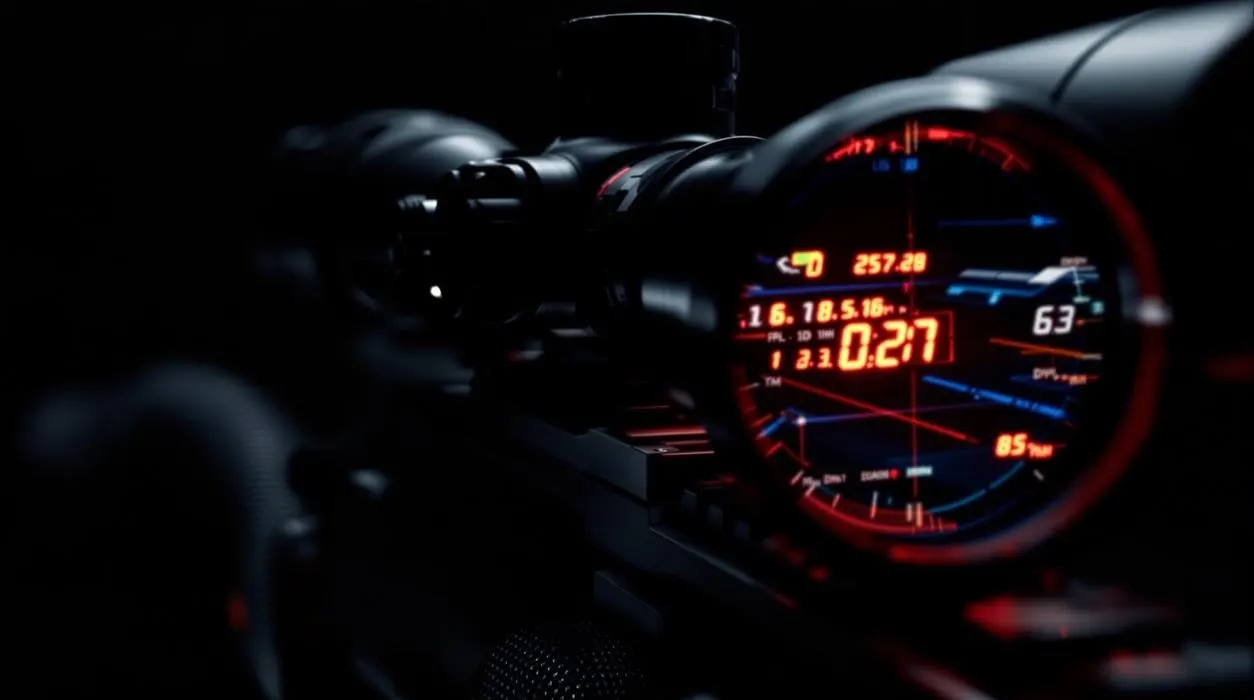
The modern smart sight is not defined by magnification. It is defined by the ability to combine an optical or electronic image with measured data. Digital displays can show range, orientation, environmental information, aiming references and recorded settings. Some systems use image processing to enhance contrast or stabilize a view; others combine daylight channels with low-light or thermal sensors.
This architecture solves several old problems at once, particularly the difficulty of presenting multiple measurements without requiring separate instruments. It also replaces a largely mechanical sight with software, batteries, processors and sensors. The optic becomes more capable, but its behavior is now affected by firmware, calibration, latency, display resolution and battery condition.
Thermal and night-vision devices expanded observation beyond ordinary visible light, although they do not make all objects equally identifiable or remove atmospheric limitations. A thermal image represents differences in emitted infrared energy, while an image-intensifying device amplifies available light. Each technology has its own contrast limits, resolution constraints and susceptibility to weather or background conditions.
Public demonstrations of guided small-arms projectiles, including the U.S. Defense Advanced Research Projects Agency's announcement of the EXACTO program in 2014, should not be confused with the routine fielding of a universal self-correcting rifle sight. Such projects showed that guidance and optical tracking could be explored together, but public claims about prototypes, tests and operational adoption must be kept separate.
The remaining limit is the quality of the input
Smart targeting systems have moved the main engineering question from "How much can the scope enlarge?" to "How accurately can the system measure, interpret and display the scene?" That change has not made optics infallible. A digital aiming mark is only as sound as the range, atmospheric data, calibration and target image behind it.
The lasting development is therefore not a single scope model or reticle pattern. It is the gradual joining of optical clarity, mechanical repeatability, measured distance, trajectory modeling and electronic display. Each addition addressed a known weakness, while introducing new dependencies that earlier users did not have to manage.
Rifle optics began as small telescopes attached to firearms. They became precision instruments only when engineers treated the mount, reticle, adjustment system, environment and ammunition as parts of the same chain. Smart systems extend that chain into software, but the old boundary remains: no optic can calculate reliable information from a scene it cannot measure clearly.